
Now that I’m retired from the classroom, summer tends to be my busy time. I just taught the grades 6-9 version of my Visual Algebra workshop. There were quite a few familiar faces among the participants. Some had seen me present at the Asilomar (California Math Council) conference, others at NCTM, yet others at a Math Teachers’ Circle. Some had even taken a version of the same workshop in the past, but felt they needed a refresher. It was great working with teachers who more or less knew what was in store.
As is usually the case, participants contributed ideas that were new to me, even though I had taught this material many times before to both students and teachers. In this post, I will share some of what I learned, even though those discoveries might not be of interest to people who are not already familiar with my curriculum creations.
Function Diagrams
In grades 6-9, I mostly use function diagrams to represent basic operations, and linear functions. These two worksheets are excellent discussion starters in pre-algebra and Algebra 1. I regret that I did not use function diagrams (and cartesian graphs) to explore signed number arithmetic in the workshop. I’ll try to squeeze that into the Boston iteration of the workshop in August. (You can still sign up for that one!)
Function diagrams, of course, have many uses beyond the basics, which I usually share in my Algebra 2 / Precalculus workshops. This did not stop Eben from experimenting by making his own diagrams, and admiring the beauty of the diagram for y = 1/x:
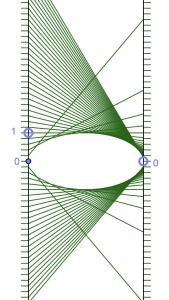
(While Eben made his version of the diagram with a pencil, on graph paper, I made this one in a few seconds using this applet. For a fun animated version of y=1/x, go here.)
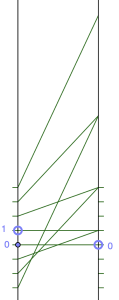
Eben also discovered an interesting phenomenon in the diagram for y = x2. See below for the diagram, showing only the in-out lines for integer x’s from -3 to 4. Notice the pairs of parallels. I had never thought about those. It turns out each pair originates in two values of x that add up to 1. Why should that be? See if you can figure it out. I will post the answer in the comments next week if no one else does.
There’s a lot more information about function diagrams on my website.
Advanced Lab Gear
The most basic (and most important) use of algebra manipulatives is the geometric representation of the distributive law — the so-called area model. Back in the late 1980’s, I designed the Lab Gear manipulatives by incorporating the best ideas of my predecessors (particularly Peter Rasmussen and Mary Laycock) into a new design that would also expand the usefulness of the tool beyond the basics. In my Visual Algebra workshop I present most of the uses of the Lab Gear, usually ending with some of the trickier applications: a geometrically correct representation of minus, a powerful introduction to completing the square, and a strategy to simplify algebraic fractions. Let me demonstrate this last one with an example: (2x+4)/(4x+2). Setting the blocks up like this reveals a common dimension, which is the common factor:
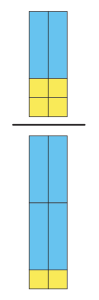
So “top and bottom” can be divided by 2. Julie noticed that the resulting fraction can be seen by looking at the blocks from the side. For example, the numerator, unsimplified is:

But looking at it from the side, you see that the simplified numerator is x+2. That’s a fun shortcut! The simplified fraction, thus, is (x+2)/(2x+1)
Also…
The one criticism from otherwise extremely positive evaluations was that I was too slow in stopping off-topic side conversations. I apologize for that. This makes me think I should write up some notes on teaching teachers: how is it the same as and different from teaching kids? Maybe in a future post.
— Henri
 Henri's Math Education Blog
Great! I too had never noticed this before. The key is recognizing the meaning of parallel arrows/segments on a mapping diagram: the difference in the source,h, equals the difference in the target, f(x+h)-f(x). For the quadratic function f(x)=x^2 this gives a quadratic equation in h, leading to the solution h=0 or h=1-2x. So x + (x+h) =1. 🙂
It would be interesting to explore this with other functions yielding similar visual niceties of mapping diagrams.
Thanks for sharing. Martin
LikeLike
Great! I too had never noticed this before. The key is recognizing the meaning of parallel arrows/segments on a mapping diagram: the difference in the source,h, equals the difference in the target, f(x+h)-f(x). For the quadratic function f(x)=x^2 this gives a quadratic equation in h, leading to the solution h=0 or h=1-2x. So x + (x+h) =1. 🙂
It would be interesting to explore this with other functions yielding similar visual niceties of mapping diagrams.
Thanks for sharing. Martin
LikeLike
Yep!
Conversely, if (x+h)+x=1, then ∆y=(x+h)^2–x^2=((x+h)–x)((x+h)+x)=(x+h)–x=h=∆x. So the average rate of change between x and x+h is 1, and thus the in-out lines are parallel.
I learned about function diagrams decades ago from Martin. He calls them mapping diagrams, and has a huge website about them: https://flashman.neocities.org
LikeLike
Henri Picciotto’s blog post “Learning from Teaching” serves as a powerful reminder that education is a continuous journey not just for students, but for teachers as well. His reflections highlight how teaching is an evolving process, shaped by student interactions, self-reflection, and a willingness to adapt.
Through my own experiences teaching 6th grade math, I’ve come to realize how much I learn from my students. Their unexpected questions and varying levels of understanding push me to rethink my instructional strategies. This aligns with Picciotto’s point that teaching deepens a teacher’s own comprehension of the subject. Every time I explain a concept in a new way—whether through visual models, real-world applications, or interactive technology—I gain a clearer understanding of the material myself.
His emphasis on adapting to students’ needs also resonates with the principles of differentiated instruction. I’ve found that no single teaching method works for every student, and being flexible with my approach has made a significant difference in student engagement and learning outcomes. Whether it’s using hands-on activities for students who struggle with abstract concepts or integrating technology for those who thrive with interactive learning, the ability to adjust teaching methods is key to effective instruction.
Another major takeaway from the post is the idea that teaching should be viewed as an intellectual pursuit rather than just a structured process dictated by curriculum standards. Many educators, including myself, start by relying on direct instruction, believing that clear explanations are enough. However, real growth happens when we shift towards more engaging, student-centered approaches like collaborative learning, inquiry-based instruction, and real-world applications.
Picciotto’s reflections also reinforce the importance of lifelong learning for educators. Professional development, ongoing reflection, and collaboration with colleagues are crucial to staying inspired and improving as a teacher. The best educators continuously seek out new ideas, challenge their own assumptions, and remain open to change.
Ultimately, this blog post is a valuable reminder that teaching is a dynamic, ever-evolving practice. It encourages educators to embrace learning as a two-way street, where both teachers and students grow through shared experiences. Moving forward, I aim to continue refining my instructional strategies, remaining open to new perspectives, and ensuring that my classroom remains a space of curiosity, engagement, and meaningful learning.
LikeLike