
As a high school teacher, my first attempts at teaching about matrices were not successful. I tried to sell them as a way to solve systems of linear equations with three or more unknowns. This was a highly technical approach to something my students were not particularly interested in. It was not a hit, and I dropped it.
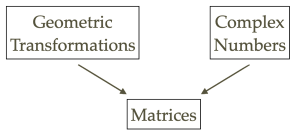
Some years later, I found a way to introduce matrices that really worked well. This is what I’ll share in today’s post, but first, I need to tell you about some prerequisites.
Geometric Transformations
My approach to matrices is based on geometric transformations. Students need to be familiar with the isometries of the plane (translation, rotation, reflection), as well as dilation. According to the Common Core State Standards, these should be introduced in middle school and/or in the high school geometry curriculum. I share some materials for that purpose on my Transformational Geometry page.
Complex Numbers
In Algebra 2, I introduced complex numbers as numbers that could be represented by points on the plane (or vectors joining the origin to those points), just like real numbers can be represented by points on a line. Complex numbers could be referred to by their Cartesian coordinates, or their polar coordinates. (Converting between these representations offered a chance for a quick review of basic trigonometry.)
To add complex numbers, we just added their x coordinates, and their y coordinates. This works like vector addition, and is readily accepted by the students. On the other hand, they are initially baffled by the definition of multiplication: using the polar coordinates, multiply the r’s and add the θ’s.
One consequence of this definition is that the square of the complex number (1, 90°) is (1, 180°), which is the real number -1. In other words, this number is a square root of -1. It deserves a special name, i, and we have i2 = -1. This leads to the a + bi notation.
Putting all this together, we need to confirm that multiplying using standard algebra in a + bi form yields the same results as the polar coordinates version. We postpone a formal proof until a later course, but we do check some special cases, and it does seem to work. Students are particularly pleased to see that complex number arithmetic supports the fact that the product of two negative real numbers is positive.
Links
I share some worksheets to support this approach on my website. Students can develop an intuitive feel for complex number arithmetic by playing the games on my Complex Numbers page. A formal proof that the two approaches to multiplication are consistent with each other is on pages 7 and 8 of Computing Transformations.
In fact, the rest of this blog post is largely based on the latter document, which is a compilation of worksheets I used in my Space course, preceded by some teacher notes. In the paragraphs below, I will specifically point to the relevant pages of Computing Transformations.
Complex Numbers and Transformations
Complex numbers can be used to find the image of a point under geometric transformations. Students readily see that complex number addition can yield the result of a translation, and that multiplication by a real number can yield the result of a dilation centered at the origin. It is less obvious that the result of multiplying by i is a 90° rotation centered at the origin. In fact, multiplying by (1, θ) is a generic way to rotate around the origin. (Page 9.)
To rotate around a point that is not the origin requires a sequence of steps: translate to the origin, rotate, translate back. Likewise if the dilation center is not the origin. The reflection of a point across the x-axis is its conjugate. Reflecting in an arbitrary line can be done in five steps: a vertical translation so the line passes through the origin, a rotation so it coincides with the x-axis, taking the conjugate, rotating back, translating back. This is getting cumbersome! It will be convenient to use matrices to make all these calculations, because composition of transformations will be represented by matrix multiplication, which can be automated.
Matrices!
After I explain how matrix multiplication works, and students practice with a few examples, I ask them to invent 2 by 2 matrices for some specific transformations (page 10): dilation centered at the origin; reflection across the x-axis, the y-axis, the y = x line; rotation centered at the origin. Because we already used complex multiplication for rotation, the task of finding the corresponding matrix is straightforward.
However there is one problem: we do not yet know how to use matrix multiplication to incorporate translations in our transformation sequences. This is solved by representing points as (x, y, 1) and using 3 by 3 matrices. Given only this information, students “invent” a matrix for translations, and adapt their 2 by 2 matrices to the 3 by 3 format (page 13). They are now able to carry out sequences of isometries and dilations as needed, by multiplying matrices. They can also create reusable special-purpose transformation matrices, such as “reflect in the line y = 2x + 3”.
The fact that students themselves are creating all these matrices yields a huge payoff in their attitudes: in course evaluations, matrices were consistently mentioned as a favorite.
Technology
Naturally, all this works best if it is supported by technology. When I used these worksheets, my students had TI-89 calculators, which allowed them to create, name, store, and multiply matrices. The tech references in Computing Transformations are to that device, especially on pages 11, 12, and 14. This worked well. After retiring, I created a GeoGebra version of the document, but I never got to try it with students. If you use it, let me know how it turns out! If you develop a better GeoGebra version, or a version using some other technology, I will gladly post it and credit you.
 Henri's Math Education Blog