
Frank Cassano and Anya Sturm are math teachers at Marin Academy, an independent high school in San Rafael. They presented on “Integrating Argumentation and Problem-Solving” at the California Math Council Northern Section meeting in Asilomar last December. I quite enjoyed their talk (which I reported on here) and asked them to summarize it as a guest blog post. As you can see below, they graciously shared the problem-solving portion of their presentation.
Readers of this blog know that I agree with the professional consensus on the importance of incorporating problem solving throughout math instruction. In our book There Is No One Way to Teach Math, Robin Pemantle and I dedicated a whole chapter to that, and it is a major feature of the curricular materials I share on my website.
Frank and Anya contribute concrete ideas on how to do this, a worthwhile complement to my approach. With their permission, I inserted some [comments of my own] into their article.
— Henri
INTEGRATING PROBLEM SOLVING SEAMLESSLY
by Frank Cassano and Anya Sturm
We are interested in moving students from viewing math as a set of operations to perform after the teacher has explained a precise recipe to follow, to viewing math as a subject involving problem solving and critical thinking. Over the past few years, we have experimented with different classroom techniques and curriculum structures to support our students in this endeavor. Our goal is to help them engage with the creativity that complex problems require — without creating more anxiety. In this post, we aim to provide you with an example of how we have integrated problem solving throughout our units.
These changes have been adopted by our entire department. We took significant department meeting time to write grading schemes for assessing and scaffolding problem solving throughout the students’ four years with our curriculum. We have found that the parallel structure throughout our math classes has helped students engage with the uncertainty of problem solving more than implementing these changes into one class in isolation.
In order to make the skill of problem solving explicit, we flipped the traditional order of presenting material. Rather than teaching a set of problems that require one strategy, and then graduating students to more complex problems once they have achieved necessary fluency, we start units by posing a question that requires students to connect various ideas, some of which may be new. This means that students start each unit making connections, solving problems, and finding patterns, to generate motivation for the content that will come in the unit. Along the way, students are forced to practice dealing with uncertainty in their solutions, and learn how to persevere when stuck. This mitigates (some of) the fear of failure that comes with uncertainty.
On day 1 of a unit, there isn’t an expectation that students can come to a complete answer on their own. Rather, we as a class try to see if we can come to a conclusion and then explicitly name that the work that the students just did was problem solving. All that is left to do is synthesize their findings — this is where new vocabulary, equations, and procedures get formalized.
[This is similar to what I call an anchor activity, which I sketch out in part 5 of “Big Picture Planning”, citing specific examples. And “formalized” is perhaps a better choice than “institutionalize”, the word I use in “Taking Notes vs. Doing Math” and There Is No One Way to Teach Math. The idea is that after students have wrestled with a concept using their own approach and language, it is important to bring them into the international institution of mathematics. That term originated among French math educators.]
Day 1 Example: On the first day of an Algebra II exponentials unit, this is what we gave the students:
- Roll 50 dice at each table group from a ‘bucket’ onto the floor, all at once. Remove any 6’s. Keep track of how many are left. Roll again until all the dice are gone.
- After the experiment, enter data into Desmos, either as coordinates or in a table. The first pair should be (0, 50), the numbers before you did your first roll. Try fitting an equation to the data.
- After a few minutes, enter f(x) = ab^x and make a and b sliders. Play with a and b to see if they can fit your data. You will have to explore and see how to change the slider endpoints. (Here is an example data set.)
This takes a lot longer than just giving an exponential equation with definitions and doing examples! But students had to engage for 30-40 minutes, and they didn’t think about what they were doing as “problem solving”. We named it after each group had already derived an exponential function for themselves, and we gave them vocabulary to go along with it.
[Starting in the days of the TI-83 calculator, I used a similar activity to launch an exponential functions unit. It differed from Frank and Anya’s version in that I followed the experiment with a discussion that led to a “theoretical” formula prior to doing any graphing. I stand by my “think first” approach. You can download the worksheet in Exponential Functions. See also Ripples about how some ideas, including this one, go viral.]
So, we’ve practiced problem solving at the beginning of a unit, but if our goal is for students to see problem solving and math as a set of skills that are inherently connected, we need them to continue flexing their problem-solving muscles throughout the unit. In keeping with the theme of problem solving first, we use open-ended warm-up questions throughout the unit to get students working together and critically thinking at the beginning of each class to set the tone for class.
[This is similar to Scott Farrand’s Think First policy, another idea I first encountered at Asilomar.]
We also use Peter Liljedahl’s tiered homework system (labeling homework problems as mild, medium, spicy) as a way to make different parts of math explicit to students. Mild problems target skill fluency, while spicy problems target problem-solving.
Mid-unit problem-solving example: a warm-up
(assigned before we do any notes on shifting the vertical asymptote of exponential functions):
Anya gets a hot cup of coffee from the café and brings it to class. When class starts, she measures the temperature at 125° F. Anya loves the lesson so much, she keeps forgetting it and doesn’t drink any of it for the whole class. After 40 min, she checked it and the temp had dropped to 86°. She forgot to drink it all, but even the next day the temperature was still above 75°. Determine a function for the temperature of Anya’s coffee after x minutes.
Throughout a unit, students practice problem solving in class, getting feedback from us, as well as concrete tools to use, and they get opportunities to practice the skills on homework as well. This allows us to include problem solving on an assessment without the student pushback of “this looks different from the problems in class.”
In order to engage with problem solving, students need to be working on a novel problem. On every assessment, the last problem is labeled as “problem solving,” and has one element that we have not touched on in the unit.
[This is better than my own practice of labeling such problems on tests as “bonus”. First of all, doing it on every assessment is powerful in affecting the culture. Second, that label reinforces the idea that the problem is intended for all students. Third, Frank and Anya suggest connections as a way to generate such problems — this would work in almost any situation, and does not rely so much on inspiration.]
In-class test problem-solving example:
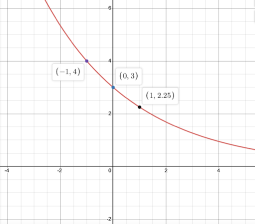
f(x)=3(0.75)^x and g(x)=f(-x)+2
- f(x) is plotted on the graph. Sketch g(x) on the same set of axes.
- Write an exponential equation for g(x).
Some context for this problem: function transformations and function notation were part of a unit, about a month before exponentials. Students who were able to retain the information had fluency for both parts of the problem – exponentials and transformations. Putting them together is not difficult if you already know how to do it (our goal is not for this to be the most difficult problem on the test), but finding that connection on your own (the novelty of the problem) is a kind of problem solving.
Here are some more examples of problem solving from tests we have given in other classes.
Engaging with problem solving requires engaging with uncertainty, and that will never be easy for high schoolers. It’s not that students were not problem solving in math class, and now they are. Rather, our goals are to promote engagement and help make explicit to students that they are practicing hard thinking which will serve them in and out of math class.
[Yes, understanding and sharing these goals is essential if we are to generate buy-in for a sufficiently challenging and effective math program. Given societal pressures, a strategy for including problem solving throughout, including as part of assessment, is just as important as creating or finding worthwhile problems for students to solve. Thanks, Frank and Anya!]
If you have any questions, or have tried something similar, reach out to us at asturm@ma.org and fcassano@ma.org!
 Henri's Math Education Blog