
In Part 1 of “Integrating Skills Seamlessly”, Frank Cassano and Anya Sturm discussed the importance of explicitly teaching the skill of problem solving, and shared powerful strategies to do that. In this post, they focus on another skill: constructing well-justified and well-organized arguments.
I’ve always agreed with this goal, but my approach consisted mostly of adding “Explain.” to various key problems in class work, homework, and assessments. I did this both for new material, in summary and review questions, and in assessments. Nothing wrong with that, of course, but Frank and Anya’s (and their department’s) policy of separating and explicitly labeling “Argumentation” questions is a valuable technique that could be used alongside the simple and ubiquitous “Explain”. If I was still in the classroom, theirs is a practice I would be sure to adopt.
Thank you Frank and Anya!
— Henri
Integrating Argumentation in Math Class
by Frank Cassano and Anya Sturm
The question “When are we going to use this?” seems to be inevitable in math class. While we need to keep open the path to further STEM education and careers, for most students the short answer is never! Most will not need to know logarithmic properties, nor solve trigonometric equations in their everyday lives after completing their math coursework.
This being said, there are absolutely transferable skills that students develop in math class.Similar to problem solving, our framework for integrating argumentation has been created and modified in collaboration with our entire department. This allows us to have a standard assessment and grading structure across the four years of our curriculum.
Our students regularly practice and are assessed on argumentation in most units. Argumentation questions are labeled on unit tests, and can vary from an algebraic or geometric proof to a statement that students need to justify using any tool at their disposal (algebra, graphing, paragraph, etc). These questions may be generalized versions of practice problems, or resemble a familiar proof structure.
Students struggle with knowing “how justified” they need to be, and even pure variable manipulation is challenging for many students. Because the skill of argumentation is already difficult, we’ve learned that our “argumentation” problems are most effective when they don’t feel entirely new. Often, our assessments echo the structure or type of problems practiced in class.
Here is an example from our trig function graphing unit in Precalculus class this year:
Mid-unit Argumentation Practice (ungraded):
If h(x) is a linear function with slope m and k(x) is a sinusoidal function with period T, prove that the period of k(h(x)) is T/m.
Argumentation portion of Assessment (graded):
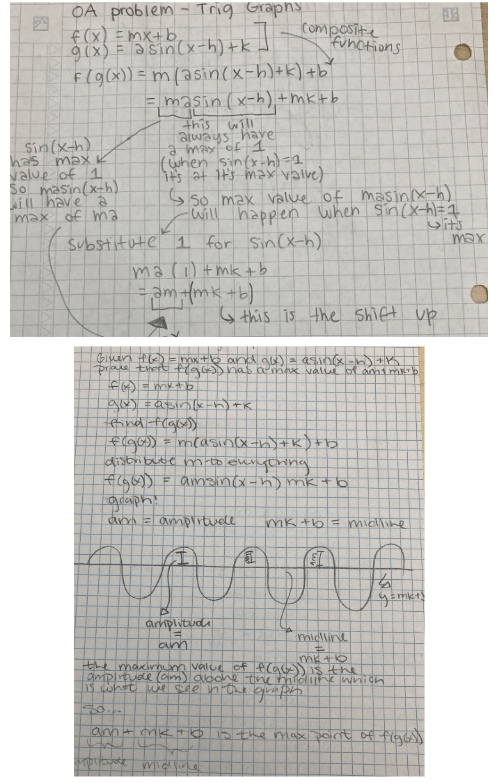
Given f(x)=mx+b and g(x)=asin(x-h)+k, prove that f(g(x)) has a maximum value of am+mk+b.
Here are a couple of examples of student work we received on the assessment. Both of these students earned full credit.
Here are some more examples of argumentation problems that we use in our Algebra 2 and Precalculus courses.
Essentially, this post is a case in favor of teaching and assessing mathematical proofs both in and out of the geometry curriculum. Forming a conjecture, and following an evidence-based logical path to a conclusion is one of the most transferable skills students can gain in math class. Students should be doing it regardless of whether we name it or not! The structures mentioned in this post help provide intentionality and awareness to the practice and performance of argumentation. Along with the skills of problem solving and procedural fluency, this is a skill students will need regardless of what they do once they graduate..
 Henri's Math Education Blog