
Michael Pershan teaches math in elementary, middle, and high school. He is a bit of a celebrity in some online circles as a thoughtful writer about math education. He deserves his fame, because his writing includes both highly practical ideas based on his actual experience in the classroom, and interesting reflections, often including intelligent reviews of academic papers. You can follow him on Substack., where he recently wrote about me! More specifically: he explored the question of what makes my curriculum creations effective. You can read the whole piece here. In this post, I will quote most of his article, elaborate on some of his points, add relevant links, and insert my own comments on what makes curriculum work.
— Henri
A conversation with Michael Pershan
Designing Great Lessons
MP: My first contact with Henri Picciotto was August 2011, the summer after I’d started teaching, when he accepted my request to join his online “Escape the Textbook!” community.
Escape from the Textbook! was a sharing and collaboration network for math teachers. We helped each other do just that, whether for a lesson, a unit, or an entire course. We did this by sharing ideas and resources online, and with quarterly meetings in the Bay Area. While the online dimension did not really take off in the way we had hoped, the in-person meetings were great. Each three-hour session was divided into two roughly equal parts: math and pedagogy. I archived some of the work we did:
- Proving Pick’s Formula (thanks, Kim Seashore!)
- Learning Tools and Forward Design (thanks, Carlos Cabana!)
- Habits of Mind (thanks, Avery Pickford!)
MP: What brought me to the group was Henri. I’d come across his essays about teaching and wanted to learn more. When I joined his community, Henri asked about my teaching responsibilities and wished me luck on my second year. (“If you’re like everyone else, it’s sure to be better than the first!”) Then he encouraged me to check out his website, where he’d shared “lots of free stuff, some of which may be useful.”
Fifteen years later, I’m still using Henri’s materials. In May, I used his Map Coloring activity with my 3rd Graders.
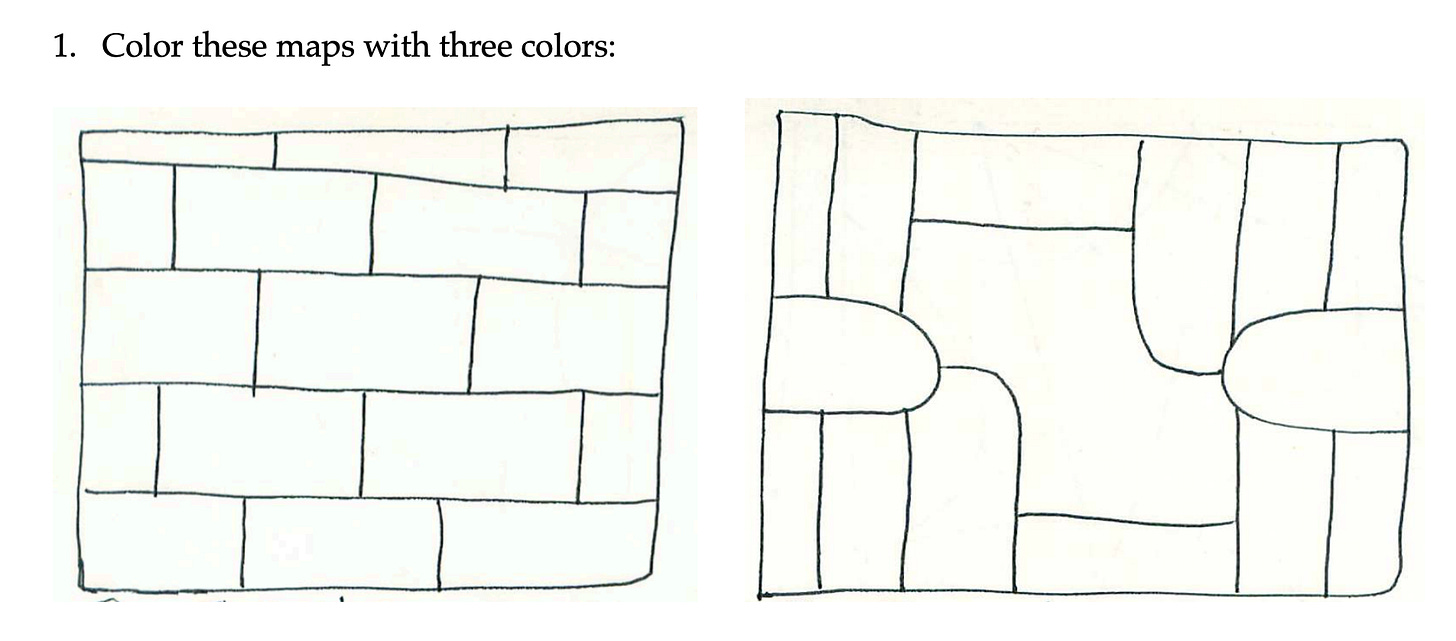
I developed this activity in the 1970’s, as a K-5 math specialist. My job allowed for much “enrichment” time at all these levels, time I often used to introduce non-curricular topics. (For another example, see Abstract Algebra.) Such topics can equalize status in the classroom, since they are new for all students, and have no substantial prerequisites. They can reveal the beauty of math, which may be hard to see when struggling through the curriculum. Many can be used in today’s Math Circles.
Some topics will work in different ways at different levels. In my own experience below third grade, the map coloring activity worked best as a whole-class discussion / discovery, with me drawing maps similar to the ones in the handout on the board, and soliciting student suggestions on where to use different colors and where to add lines. The worksheets are intended for grades 3 and above, and I’ve even used them successfully with teachers.
MP: Henri’s Geometry Labs sheets are especially wonderful—this year my 7th Graders learned about polygon angles from them.
What makes Henri’s activities work so well? I’ve found myself asking this often. Here is what I can currently point to.
A Single Set of Instructions
I’ve used Henri’s “Clock Angles” activity in elementary, middle, and high school. The instructions are simple: draw hands on the clock to represent times. Don’t forget that the minute hand moves over the course of an hour!
It’s not hard to imagine a more finicky version of this activity. “Draw 5:00.” “Draw 5:30.” “Where is the hour hand at 5:30?” and so on. This might help us feel confident that the student will encounter important ideas, but with a cost—it’s taxing to read new instructions, and it interrupts some of the fun and flow of the core puzzle.
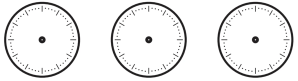
(“Clock Angles” is Lab 1.3 in Geometry Labs.)
Some of my best creations are indeed in the form of simple instructions which allow students to find their own way through the activity. This is usually followed by a more guided discovery format, but it’s a good way to ready students for that next step. Here are some examples along these lines:
- Make These Designs (this is probably my most popular worksheet, declared by Dan Meyer a “hall of famer”)
- Tiling with Triangles and Quadrilaterals (the opening of Geometry Labs 7.3)
- Sixteen Function Diagrams (the idea here is to find the y = mx + b formula for each diagram — obviously, the prerequisite is knowing about function diagrams)
This sort of format cannot be used for everything, but it has some important advantages. It works with a heterogeneous student population, as students find their own level of challenge. It reduces unhealthy competition and racing, as students follow different paths. Perhaps most importantly, it puts more responsibility in the students’ hands and leads to more ownership of the activity and the underlying concepts. Sequencing discovery in advance and assuming a particular sequence is right for all students comes with a cost, as Michael says. (Of course, it is to some extent inevitable for most guided discovery curriculum. Still, it would be great if Desmos would create a version of their Activity Builder that would allow students to blaze their own trail through an activity.)
Another interpretation of Michael’s observation about instructions is that, when possible, they need to be simple. An example of this when using algebra manipulatives is to start with “Make a Rectangle”, which is more likely to be understood than “Illustrate the distributive rule.” The distributive rule and factoring are the goal, but they come later, and can be built on the “Make a Rectangle” foundation.
MP: One of my favorite essays by Henri is “Nothing Works.” He argues for non-dogmatism about teaching, as the job is too varied to allow for principled consistency. I think that’s right. Many of Henri’s activities in Geometry Labs have multiple questions or sets of instructions, and at times that’s the right move. But when you can get away a single prompt that generates rich mathematical activity, that’s definitely the way to go.
Heading Towards Generalization
“Number Pyramids” are now fairly widespread in math curricula. I’ve seen them in the Beast Academy books and on NRICH. What makes Henri’s version stand out is his middle stance between exploration and explicit instruction. It’s only midway through the activity that a student might realize they’re in the presence of an interesting mathematical generalization.
(In a number pyramid, each number is the sum of the two numbers below. This activity has become one of the most popular on my site.)
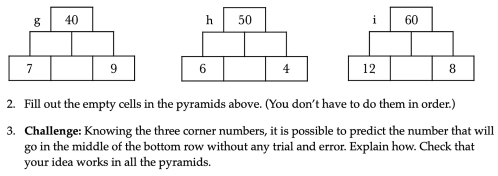
MP: Sometimes he interrupts an activity with a little STOP sign to ensure that students pause and reach for a generalization, as in his fantastic lesson on simplifying radicals.
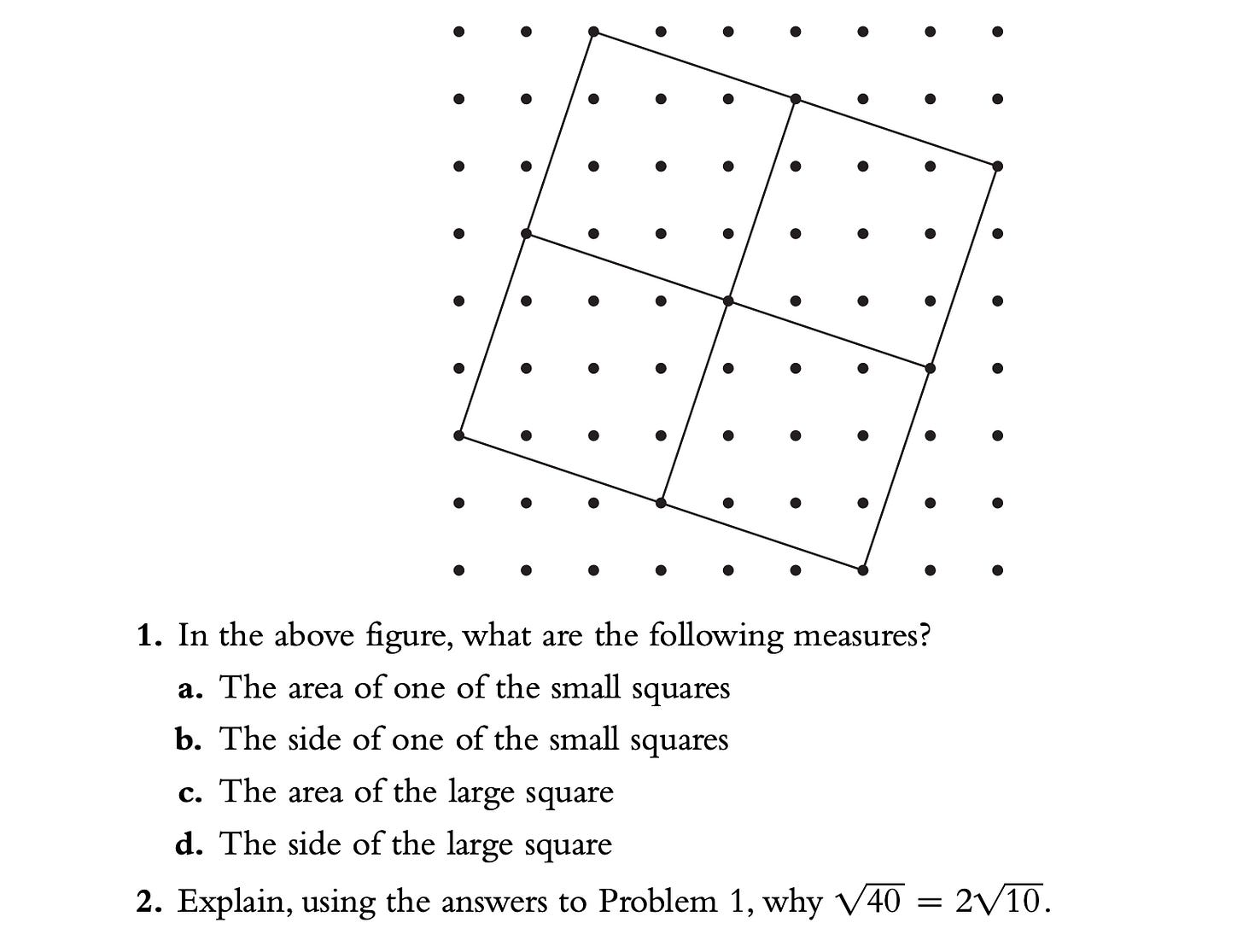
(“Simplifying Radicals” is Lab 9.3 in Geometry Labs.)
MP: Focus — Henri knows the one thing the activity is asking kids to do, and the one thing he wants them to understand from it. His activities are consistently oriented towards a single meaningful, interesting mathematical idea. Sometimes these are conventional theorems or formulas, such as the polygon interior angle sum. At other times, as in Number Pyramids, the realization will never show up on any test. But these materials reflect a belief that what makes mathematics joyful isn’t just discovery—it’s about the pleasure of understanding.
(Polygon angles are the topic of Geometry Labs 3.8.)
Yes, understanding is hard to transmit, but it’s the central part of our mission. I tried to break down the meaning of that word in this post, one of the most visited on my blog.
MP: A Teacher’s Eye for Design
None of this would matter if it weren’t for something more prosaic: the materials are easy to use. This reflects Henri’s years of experience as a classroom teacher.
I often find myself reformatting materials before class. I add white space. I clarify questions. I make new diagrams, or have to replace confusing contexts. This happens even more often with mathematically rich materials, as designers with command of advanced mathematics rarely also have experience teaching young children.
Henri, however, has taught elementary, middle, and high school students. His pages reflect a teacher’s perspective on curriculum design. Every activity is contained on one or two pages, so they print nicely. There is ample room for students. He often includes blank tables that help students organize their results. There are discussion questions (useful for the teacher) included in the student materials, which makes it easier to guide the session.
You can see this in his “Polyomino Perimeter and Area” activity—his materials are classroom ready.
Well, that is only true of some of the materials. For Geometry Labs, some of the credit goes to my editor, Dan Bennett. Algebra: Themes, Tools, Concepts, a book I co-authored with Anita Wah, contains many terrific activities, but all would probably benefit from the sort of reformatting Michael recommends. Likewise, my Algebra 2 and post-Algebra 2 materials are great, but their format is not especially user-friendly. By 10th or 11th grade, that is not a fatal flaw, but I do know of teachers who choose to reformat those activities.
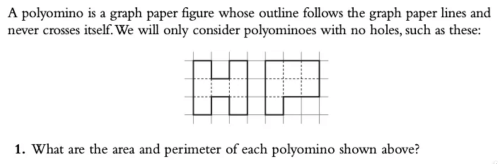
As for “Polyomino Perimeter and Area” (Geometry Labs 8.1) it is my favorite lesson. I have taught versions of it at all levels in grades 4-12, to teachers, and even to parents. The big question it addresses: for grid paper shapes of a given area, what is the minimum perimeter? the maximum? Everyone can get started and get partial results, but completely nailing it with a formula is very difficult. Like many of the activities cited here, it is “low threshold, high ceiling”, another feature of great lessons.
MP: I’ve been teaching since 2010, writing about teaching since 2011. It has occurred to me, once or twice, that this is unusual. Most people who write or design interesting materials do it from outside of schools.
After 43 years in the classroom, I have joined the ranks of people who want to support teachers, without being teachers!
While reading what Michael wrote, I realized that my most effective lessons do indeed follow the guidelines he uncovered: using simple instructions, going from specific to general, focusing on a central concept, and making ready-to-use worksheets. But when creating curriculum, I rarely go through these as a mental checklist — I am more intuitive — so how do I get there? What comes to mind right now are two other ingredients that help to design effective lessons.
- After an initial draft, I try to go through it pretending I’m a student. Is this interesting? Can it be made interesting? Is this so easy it’s boring? Is it so hard it’s discouraging? I can do this more effectively than some curriculum creators because my decades in the classroom have helped my ability to inhabit the student mind.
- Even so, my lessons rarely hit the bull’s-eye the first time. Once I see what actually happens with students, I adjust the lesson accordingly. Not all the materials on my website have gone through this iterative process, but many have, and are the better for it.
MP: I have no doubt that I’ll be drawing on Henri’s materials in my teaching next year, and for many years to come. I’m glad that I’ve had to chance to be part of Henri’s communities, and grateful that someone with Henri’s many and varied talents ended up in teaching. When I think about the kind of classroom career I’d like to have, I think of Henri.
Henri—thank you!
Thank you, Michael, for your praise and for your insights!
— Henri
PS: Dan Finkel also responded to Michael, and I may comment on his response in a future post!
PPS: For more about my views on math pedagogy, readers of this post can get There Is No One Way to Teach Math: Actionable Ideas for Grades 6-12, a nearly encyclopedic compendium which I co-authored with Penn mathematician Robin Pemantle. Read about the book, and check out its table of contents. If you like what you see, purchase it!


Hi Henri,
I tweaked the colors of the images in your map coloring handout so it would print better on my printer. (The whitespace on the maps was off-white instead of pure white and it was showing up as a dirty grey on my B&W laser printer.)
Here’s the updated document in case you want to make it accessible to others. Thank you for all the amazing resources!
Thanks,
Celeste
LikeLike