
For several years, I was quite active on Twitter. What got me to stick with it (until its takeover) was that it was a good place to discuss math teaching with like-minded educators. In fact, it was a good place to meet such educators. Among them: Michael Pershan, Dan Finkel, John Golden…
Not long ago, Michael wrote a lengthy blog post in which he discussed what makes many of my lessons “great” (as he put it). In my response, I quoted him extensively, and inserted some comments and links. Dan Finkel wrote his own response to Michael. In it, he too praised my work. Since I am not humble, I’ll quote some of his compliments here:
[Henri thinks] about what mathematics he wants his students to be doing, and how he wants them to experience the doing of mathematics. What makes him worth looking at is that he sees mathematics as fundamentally rich and interesting, and is trying to craft experiences that give students meaningful choices and greater ownership, that invite them to make conjectures and explore deeper generalities […], and, maybe most vitally, he’s choosing interesting content to explore! I see slanted squares and polyomino area and perimeter and my first reaction is: “Wow – it’s great to see that Henri is offering such excellent content to students. Those are such interesting environments to explore, and so rich.” There are a lot of user experience moves that are good too (asking for a formula for maximum perimeter of a polyomino, but a pattern for minimum perimeter shows that someone has spent some time with that particular structure. Explore it and see why!)
(I share “Polyomino perimeter and area”, my favorite lesson, in Geometry Labs 8.1-8.3. “Slanted squares” is a key step in the geoboard exploration that leads to a proof of the Pythagorean theorem, as featured in Geometry Labs 8.4 to 9.4.)
In a comment on Dan’s piece, John Golden adds to this avalanche of compliments:
Henri has built so much over so long. You could easily start by just trying one activity as an add-on […]. His Math Education Page is a treasure trove from one of the most creative teachers I’ve ever met.
But enough wallowing in all this praise. I’m here to discuss Dan Finkel’s thought-provoking post.
Form and content, pedagogy and curriculum
You should read Dan’s whole piece, but I’ll quote parts of it here. Dan discusses…
a dynamic in math education relating to what’s most vital to focus on when it comes to creating mathematical experiences/curricula/lessons/etc. We could consider a dial between two points of view: does math class just have a PR problem, and need to be marketed better, have better user experience, better graphics, better production values, etc., but not require changing what we teach? Or does math class have a fundamental issue in the content itself, and need a deeper overhaul?
Dan Meyer gave a well-known TED Talk that articulated the former perspective: Math class needs a makeover. And Paul Lockhart’s “Mathematician’s Lament” argued from the other end, that the stuff we teach in math class is fundamentally off, and needs a total overhaul; we might call this the “Math class needs a heart transplant” perspective.
Dan Finkel gets at an important distinction, but his nomenclature is somewhat biased, as “makeover” implies superficiality, while “heart transplant” implies a serious crisis in content. I would rephrase it:
Pedagogy (how we teach) <——————————————> Curriculum (what we teach)
He goes on to say that different math educators fall somewhere in that spectrum. I don’t disagree. I am so constitutionally committed to the “heart transplant” point of view that during my ten years teaching K-5 I dedicated a staggering amount of class time to so-called “enrichment” topics. In the subsequent 33 years teaching high school, I didn’t have such opportunities, so I made it a career-long quest to find ways to get at curricular content by way of genuinely mathematical approaches, initially giving as much agency as possible to students, and following up with guided discovery lessons. The activities Dan praises above, and many of the ones Michael likes are the outcome of that quest. (And what I could not fit in the school day I shared in math circles.)
However! The reality of being a math teacher is that one must teach the curriculum. Students need to know sufficient school matheatics to have access to STEM careers should they want to pursue those. And frankly much school math is required to be an educated adult. Yes, I contributed many ideas on how to do it in a way that makes it possible for students to take ownership of their learning while doing real math. But that does not mean that the “makeover” point of view is flat-out wrong. In fact, it is the nature of a teacher’s job to be pulled in two different directions: concern for the student, and concern for the discipline. The former requires sophisticated pedagogy, the latter requires rich mathematical content. It is important to understand they’re not the same, but it is a mistake to think of them as mutually exclusive.
Embracing contraries is an essential requirement for effective teaching. Some years ago, I identified two dozen pairs of apparent opposites and created a worksheet to help teachers think about where they fall on those axes. Some examples: forward motion vs. review; routine vs. variety; focus on correct vs. incorrect answers; and so on. In the introduction to the worksheet, I stated:
There is no one way. Within each category, there is something to say for each of the options, and for any other option on that spectrum. Learn how to navigate between the options, adjusting to the specific conditions of your class. As you gain experience, you will learn new techniques, broaden your repertoire, and gain the flexibility that makes for good teaching.
In other words, knowing where you fall on a given axis is a good way to start thinking about your teaching. But teachers don’t have the luxury to believe in and practice a single approach. As a consultant and curriculum developer, I can choose whatever stance I want. But things are different for classroom teachers: students, schools, and societal circumstances are diverse. Nothing works all the time everywhere. Teachers must be eclectic, and be ready to behave in ways that don’t come naturally. (I wrote about this repeatedly. See for example No One Way, and the posts I link to in there.)
In fact, the art of teaching consists largely of constantly navigating along those axes, sometimes emphasizing one end of the spectrum, sometimes the other, and often paying attention to both. In the end, it is not that easy to disentangle “makeover” from “heart transplant”. Where do the mathematically engaging tasks that empower students stop, and the interface concerns begin? Done well, they are interlaced, and each reinforces the other.
Here is an example. A standard use of algebra tiles is to illustrate the distributive property. This is an improvement over just stating the property, but it doesn’t go as far as the Lab Gear approach I developed. I suggest starting with “Make a Rectangle” challenges, a sort of geometric puzzle which can be introduced without a mention of the distributive property. Students are given some blocks, e.g. two x^2 blocks, and four x’s, and asked to arrange them into a rectangle.
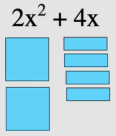
Here is one way to do it:
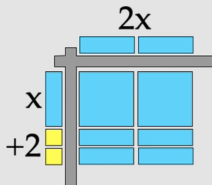
Because the area of a rectangle is equal to length times width, we see that:

This is an extraordinarily effective way to get into this topic. The instructions are simple, and understood by all students. Doing this repeatedly with different sets of blocks lays a foundation for further reflection and discussion. We have performed a substantial makeover: not only simple instructions as favored by Michael, but also a hands-on, visual context that works as interface to an important algebraic concept. But what is going on mathematically? Breaking with tradition, we are starting with what are essentially factoring problems. Those are intrinsically more interesting than a boring application of the distributive law (e.g. “FOIL” practice, which can happen later, once the concepts are mastered). Students are being asked to solve geometric puzzles through their own agency. As far as I’m concerned, this qualifies as doing real math — it is the sort of heart transplant Dan Finkel favors. I cannot separate form from content.
Because I was in the classroom for decades, I had to find ways to grow on both those fronts. Unlike the one-hit wonders that characterize some in our profession, I was able to contribute ideas to a wide range of topics: fractions, algebra, geometry, and so on. As well as to a wide range of approaches: manipulatives, technology, and conceptual learning tools such as the ten-centimeter circle and function diagrams. After decades of sharing curricular materials on my website, I co-authored a whole book that primarily focuses on pedagogy! (There Is No One Way to Teach Math: Actionable Ideas for Grades 6-12.)
In other words, while I agree with Dan’s assessment of where I fall on the makeover-to-heart-transplant spectrum, I learned that the best teaching requires a wide-open attitude and the willingness to navigate the whole spectrum: solid math requiring student intellectual engagement and a presentation that makes that possible.
Makeover or heart transplant? Both!
Many thanks to both Michael and Dan for helping me think about all this!
— Henri


I totally agree with this reflection, Henri. I was actually reconsidering my original post, and feeling like I needed to get “intrinsically interesting” (i.e. heart transplant) and “easily usable” (i.e., makeover) on two separate axes. They’re not inherently in conflict.
When they are pitted against each other is when you’re considering time as a factor. If you just have one workshop, what’s your emphasis? Should you start with the makeover axis or the heart transplant axis? There, perhaps, is where we see the real difference emerge between people’s perspective.
LikeLike