
Hi all,
Given my advanced age and assorted medical issues, I’ve been thinking about decluttering. I have two file drawers full of curricular materials I developed before I started using computers to create and store them. While I often look at old materials on my computer, I pretty much never open these physical folders. I plan to go through them at a leisurely pace, starting today. I will scan what seems worth preserving, and share some of what I come across on this blog.
Back in the 1970’s I was a math specialist in grades K-5. I tried to squeeze in as much so-called “enrichment” math as I could into what time I had. But a big part of the job, back then, was teaching calculation algorithms and making students practice them endlessly. Here is an activity I used in order to make the practice feel more purposeful:
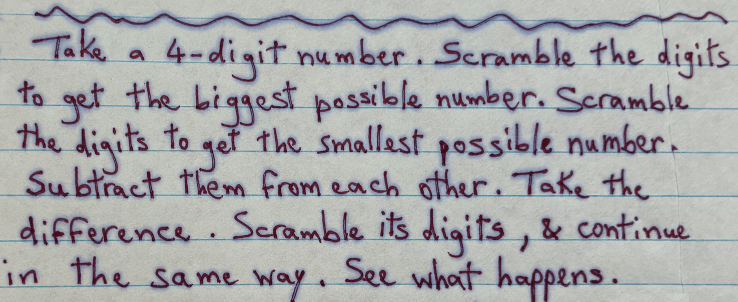

Even though the punch line of the activity is interesting, I would not assign this today, as it seems unnecessarily tedious. Subtractions involving fewer digits, accompanied by discussion, would be useful: Why does this work? Is there another way to do it? And so on. Also useful: practicing estimation and mental calculation. But multi-digit pencil-paper work only turns students off to math, with no benefit in an era of electronic calculation. The claim that such calculations help to develop students’ number sense is bogus: the algorithms are specifically designed to make people fast and efficient, with no opportunity to think.
Still, I would assign this activity as a supplement to a student who would enjoy it. (My wife enjoyed it!) Also, it would definitely make a good assignment in a computer programming class: breaking up a string into its elements, sorting them, subtracting the resulting numbers, doing that repeatedly, figuring out when to stop… But children are not programmable devices, so I would spend precious classroom time on other work.
— Henri
PS: I will share more from my file cabinet in future posts.


>
LikeLike