
From my file cabinet, a handwritten three-page exploration of the powers of two, probably intended for the fifth graders I taught in the 1970’s. It involved a fair amount of calculation, but it was calculation with a purpose!
I will summarize the worksheet in this post. You can download the whole thing here.
Page 1:
The worksheet starts with definitions of power, base, and exponent. Then, students are asked to calculate the powers of two, from 20 up to 219. Those, or at least some of them, came in handy in the subsequent work. If I were to use this worksheet now, I would probably stop earlier, maybe with 212.
Presumably students were to figure out what 20 means by extending the pattern backwards from 24, 23, 22…
Page 2:
Use the powers of 2 to build numbers by addition. For example: 35 = 34 + 1 is incorrect because 34 is not a power of 2, but 35 = 32 + 2 + 1 is correct. You are not allowed to use any power of 2 more then once. For example: 12 = 8 + 2 + 2 is incorrect because 2 was used twice, but 12 = 8 + 4 is correct. Which numbers can be built this way? Which can’t? Experiment and find out.
Note that the activity stops short of introducing base 2. While that is the foundation of this activity, it is not the focus here. The idea, rather, is to help students discover a strategy for doing this efficiently, and thus develop their number sense.
Herbie would like some advice about how to build a number this way. Write a paragraph to explain it to him.
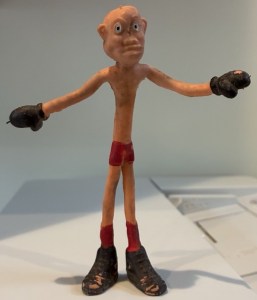
Herbie was a little doll representing a boxer, beloved by my students. I would talk to him, or have students talk to him. I lifted him to my ear to listen to his responses which I then shared with the class. (Why a boxer? No reason. It just happened to be what I had.)
Page 3:
- Adding powers of 2:
20 + 21 =
20 + 21 + 22 =
20 + 21 + 22 + 23 =
and so on. - What is 20 + … + 219 ? What is 20 + … + 2n ?
- Explain the pattern.
- Multiplying powers of 2: Students had to find, e.g., 22 ⨉ 23 and write the answer as a power of 2.
- Do you notice a pattern? Explain it.
Looking back at this, I notice that I expected a lot in the way of pattern recognition and explanations, two key ingredients in a guided discovery pedagogy. That didn’t change when I started teaching high school some years later.
Again, you can download the worksheet here.
— Henri

