
From my file cabinet, a worksheet about Egyptian numerals, and associated cards. The worksheet includes the answers in red.
Ancient Egyptian arithmetic was base ten, but did not involve place value. Instead they worked with what I decided to call shape value:
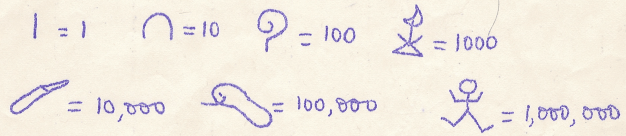
I imagine I used this alternate representation of numbers to reinforce understanding of place value, addition, and subtraction.
While it may make sense to use shape value before introducing place value, evidently that is not what I did: the worksheet starts with a reminder of place value from ones to ten billions.
Inexplicably, my own answers to #3 were in our own (Arabic) numerals, which is not what was asked. Here are the correct answers:
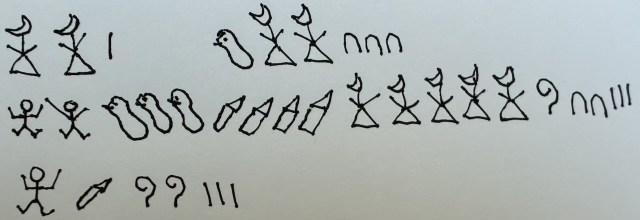
I am now ready to answer #4!
What I like about Egyptian numerals: It’s another base ten representation for numbers, which on the one hand helps to understand base ten and place value, and on the other hand shows that place value is much preferable. (Which may explain my “incorrect” answer to #3. I didn’t have the patience to use Egyptian numerals! 🙂. )
What I don’t like: It can take a long time to write a large number, as you can see above.
Note that #5 is yet another representation of base ten, this time using scientific notation in disguise.
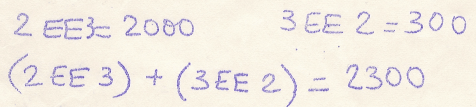
Apparently I was a fan of multiple representations before they were cool!
As for the cards, I suspect I might have used them to model addition and subtraction. Students could use the cards to model the operations, before or after going through the worksheet. I also had my own larger cards with velcro backing which I could stick to a special board that all students could see.
Note that to save students from having to count out eight ones to represent 8, say, they could use a five, a two, and a one. Activities could involve (say) trading a ten for two fives in the course of doing a subtraction, or two fives for a ten when adding. This could precede or follow what we called chip trading, now better known as exploding dots. (Some years later I used the “five” shortcut idea when designing the Lab Gear: I included 5, 25, 5x, and 5y as single blocks, which makes those blocks far more user-friendly than algebra tiles.)
For another classroom use of ancient Egyptian arithmetic, see this fractions challenge for somewhat older students.

