
From my file cabinet, a worksheet on using the distributive property in mental calculation, which I created when I taught K-5 in the 1970’s. This is one that has not lost its relevance, in spite of the advent of electronic calculators and computers.
In general, we should spend less time on multi-digit pencil-paper algorithms. Students know that no one in the real world makes calculations that way, and it’s hard to justify spending an enormous amount of time practicing those in the hope of matching the speed and accuracy of inexpensive machines.
Still, number sense remains crucial. It can be enhanced by practicing estimation and mental calculation. Both of those require familiarity with basic addition and multiplication facts. (For that, I recommend Dylan Kane’s online applet: Pulse.)
“Do-it-to-both” (also known as the distributive property) is a key strategy in mental calculation. The worksheet includes these examples:
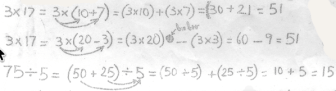
Students can practice with a version of the worksheet. This should be followed by a debrief discussion, and with frequent “head problems”, perhaps as opening warmups. (Robin Pemantle and I discuss this in Chapter 3 of There Is No One Way to Teach Math. The book is aimed at grades 6-12, but this skill / understanding remains relevant until at least ninth grade!)
Note the generalization on the bottom right of the worksheet. I don’t remember the extent to which students were able to fill out those blanks. It may have been part of the debrief discussion?
— Henri

