
Hi all,
Given my advanced age and assorted medical issues, I’ve been thinking about decluttering. I have two file drawers full of curricular materials I developed before I started using computers to create and store them. While I often look at old materials on my computer, I pretty much never open these physical folders. I plan to go through them at a leisurely pace, starting today. I will scan what seems worth preserving, and share some of what I come across on this blog.
Back in the 1970’s I was a math specialist in grades K-5. I tried to squeeze in as much so-called “enrichment” math as I could into what time I had. But a big part of the job, back then, was teaching calculation algorithms and making students practice them endlessly. Here is an activity I used in order to make the practice feel more purposeful:
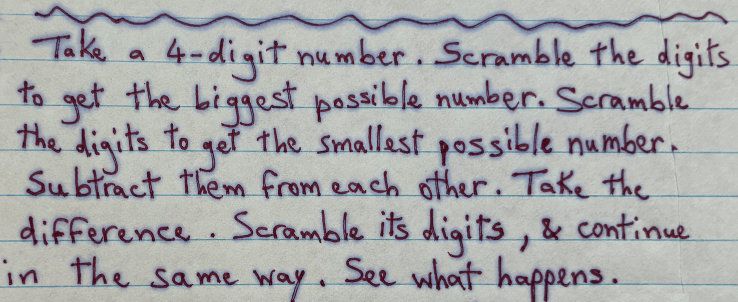

Even though the punch line of the activity is interesting, I would not assign this today, as it seems unnecessarily tedious. Subtractions involving fewer digits, accompanied by discussion, would be useful: Why does this work? Is there another way to do it? And so on. Also useful: practicing estimation and mental calculation. But multi-digit pencil-paper work only turns students off to math, with no benefit in an era of electronic calculation. The claim that such calculations help to develop students’ number sense is bogus: the algorithms are specifically designed to make people fast and efficient, with no opportunity to think.
Still, I would assign this activity as a supplement to a student who would enjoy it. (My wife enjoyed it!) Also, it would definitely make a good assignment in a computer programming class: breaking up a string into its elements, sorting them, subtracting the resulting numbers, doing that repeatedly, figuring out when to stop… But children are not programmable devices, so I would spend precious classroom time on other work.
— Henri
PS: I will share more from my file cabinet in future posts.


>
LikeLike
Henri,
Glad to read about this activity as I have just been reading an article from the MAA journal, Math Horizons, about the Kaprekar Constant which uses the process you describe! When I taught middle school 30 years ago, I used a Marilyn Burns activity with subtracting two digit numbers like this. – Mark Koester
LikeLike
Thanks for sharing Henri Sent from my iPadOn Oct 18, 2026,
LikeLike
The distinction you made about calculation algorithms being designed for speed rather than actual number sense is very sharp. Focusing on fewer digits alongside questions about why an approach works makes far more sense for genuine discussion. It is also a neat perspective that an iterative routine like this translates well to a programming exercise, where repetitive sorting and subtraction belong. Looking forward to reading more notes from your cabinet.
LikeLike